Sunday, July 17, 2011

Garden Status and More Lettuce

The garden continues to grow, and we have green tomatoes, small peppers, and baby cucumbers.  I gave some additional training to the tomato and cucumber plants using Velcro ties.  This gave the peppers and vegetables in the middle of the garden some more room.  Here is the garden today (7/17/2011).


Here are the vegetables in the middle.  We have been harvesting lettuce and basil every day for salads and appetizers.


In an effort to keep the lettuce yield going all season, I germinated lettuce seeds indoors and transplanted a few of them to the garden today, adding a little blood meal around them for nitrogen.  The hot weather isn't supposed to support lettuce, but the plants are doing well so far, so I'll keep giving them a chance to give us salads.  I put the seedlings between the existing plants in one of the squares and will completely cut away (eat) the existing plants in this square as the seedlings mature.  We will keep the lettuce density at three lettuce plants per square foot.  I'll transplant seedlings to the other lettuce squares as we cut (eat) those.


I applied some more Safer BT, Captain Jack, and Safer Tomato/Vegetable Insect Killer today.  I don't see plant damage; this is just a preventative measure.

Saturday, July 9, 2011

Bugs: Nuk'em

Although I haven't noticed a lot of damage by bugs, I'm seeing more bugs in the garden.  I'm putting three types of organic pesticides on the garden as a preventative measure:  Safer Caterpillar Killer (Bacillus Thuringiensis (BT) / Kurstaki Strain), Captain Jack's Deadbug Brew (Spinosad (Spinosyn A and Spinosad D)), and Safer Tomato and Vegetable Insect Killer (Pyrethrins and potassium salts of fatty acids).  My garden neighbors have seen cabbage worms and cabbage worm eggs on their leaves.  I haven't seen them on my plants yet, and I'm working not to.  I'm a bit concerned that BT will affect my composting worms, but initial research says otherwise; I'll keep looking into this.


Going Up... More Green

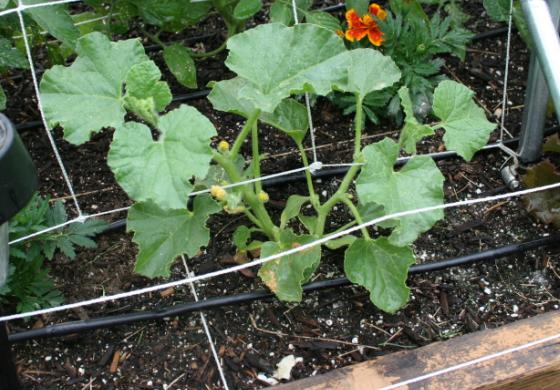
After returning from our backpack last weekend, we saw a big change in the garden.  The tomatoes, cucumbers, and string beans have surged.  I tied the cucumbers with string to the netting to encourage them to grow vertically and keep them at least close to their allocated square footage.


The tomato plants keep climbing and green tomatoes keep forming.


The pepper plants don't look the healthiest I've seen, but the peppers are growing.  The pole beans have reached the top of the trellis.


This is the space between the string beans/cucumbers and tomatoes.  The lettuce, onions, garlic, carrots, basil, and strawberries seem to be doing well.


We've got quite the miniature farm going on.

Regular Fertilizing

Today (7/9) I supplied another round of fertilizer to the garden.  My plan is to water-in organic fertilizer every two weeks.  I picked up some Age Old Bloom fertilizer that is high in phosphorous to promote development of the fruit.  Two ounces of this fertilizer in two gallons of water covers the entire garden.


As part of my regular fertilizing, I'm also putting a small amount (a tablespoon or less per square foot) of bone meal, blood meal, and epsom salts on the surface of the soil near the plants.  I want the bone meal for phosphorous and calcium, the blood meal for nitrogen, and the epsom salts for magnesium near the tomatoes and peppers.  I'm intentionally adding the nitrogen to keep the leaves growing on the tomatoes so that I can keep the vertical growth happening until the plants reach the top of the trellis.

End-of-June Harvest and Status

On 6/29 our lettuce looked good enough to eat, so we did.  Our strategy is to pick the outer leaves when we want a salad.  Contrary to common advice, our lettuce is doing quite well in the hot weather.


The lettuce has a good flavor and texture.  It's not at all bitter and has a soft but "meaty" consistency.  We're mixing it with those store-bought vegetables until the garden starts producing other salad accoutrements.


We have the beginnings of tomatoes forming.  The plants are covered in blossoms, and a few green tomatoes are beginning to grow.


The basil and garlic are doing well, and the cantaloupe has begun to grow more rapidly.


Week after week, the green keeps expanding.

Saturday, June 25, 2011

Garden Status

The garden is looking quite green with the warming weather.  The tomato plants have accelerated growth and are no longer showing signs of new fungus damage.  The string beans and cucumbers have taken off, and carrots are looking stronger.  We added marigolds in a few spots as a companion-planting measure.  Marigolds are supposed deter tomato hornworms and other bad bugs.  The tomatoes, cucumbers, and peppers are showing evidence that we might eventually get a harvest from the garden.


Worms in our Bed

We put worms in our garden bed to help fertilize the soil through vermicomposting.  I ordered Uncle Jim's 1,000-Count Red Wiggler Live Composting Worms from Amazon.com.  While tracking my future buddies through the UPS system, I got a message that they were diverted to Florida due to a UPS sorting error and would spend an extra weekend there.  I called UPS, explained that there were live passengers aboard the box, and requested that the package be routed overnight to me.  It got here with most passengers safely intact, except for a few that escaped the cloth bag into the cardboard box.  It looks likely to me that a few wigglers made it onto the UPS conveyor belts and possibly took a ride with other packages to other destinations.


I loosened a small area of soil and dumped the bag of worms (in peat moss) on the garden.  Some of the worms quickly left the pile and squirmed across the top of the garden.  A few tried to make a break from the garden, but once they got half-way across the lumber border, they turned back to the soil.


The worms dispersed themselves from the peat pile within a couple days.  To feed the worms, I found the idea for a worm tower on the web.  A worm tower is a place to put mulch material from the kitchen into the garden and a place for worms to feed.  My worm tower is a 4-inch PVC pipe that is buried about halfway into the soil.  I drilled 1/2-inch holes into the portion of the pipe that gets buried into the soil.  As the theory goes, the worms enter the holes, eat some tasty mulch from our kitchen, exit through the holes, and leave castings and nutrients for our vegetables to absorb.  It's a cycle from our kitchen, to our garden, and back to our kitchen, whereby worms help turn banana peels into tomatoes for our salad.


The worm tower has a drain cap loosely inserted into the top of the PVC pipe.  I've been grinding up vegetable scraps from the kitchen in the food processor and dropping the resulting mulch slurry into the tower.  I grind the mulch so that it decomposes more quickly.  My recent Googling tells me that worms eat the bacteria that grows on the food waste.  Worms apparently love melon and cantaloupe rinds; like fruits, vegetables, crushed egg shells, and banana peels; and only tolerate citrus, onions, and garlic.  Yum, can't wait for tomatoes.


Organic Fertilizer

We first figured that the compost in the soil mixture would be enough to fertilize the plants, but then decided to supplement the soil with organic fertilizers.  We added the following components; we scratched powdered fertilizer into the top one inch of soil, and we diluted concentrated solutions in a watering can and watered-in.

  • Fish emulsion (whole garden)
  • Blood meal (whole garden)
  • Bone meal (whole garden)
  • Tomato fertilizer ("Mater Magic") (around the tomatoes)
  • Epsom salt (around the tomatoes and peppers)
  • Kelp solution (whole garden)


The tomato fertilizer is a little redundant; it contains meat meal, hydrolyzed feather meal, bone meal, blood meal, and sulfate of potash 5-5-9 plus 4.5 calcium.  The plants have perked up in the warmer days, but I like to think the fertilizer and associated effort helped.


Saturday, June 11, 2011

Water System Installation

This week I installed the underground water system for the community garden to provide one hose bib for each plot.  Five pipes/posts each have a pair of hose bibs.  The water source is a hose bib on the side of the pool utility building; a hose connects the source bib to underground PVC pipe.  A few volunteers helped clear out the shallow ditch, and the installation attracted some spectators.


It took three evenings to assemble the vertical faucet posts and install the underground pipes.  After testing, I corrected two leaks (only!) at one of the hose bibs and at the input hose.


The T posts with the hose bibs are held up by posts (EMT) driven into the ground.  Hose clamps hold the PVC to the EMT.  One gardener remarked how we are creating a deluxe community garden.  I must agree.


I added a Y-adapter and programmable water timer to the hose bib at my plot.  The water timer controls watering via drip lines throughout the plot.


The drip lines have emitters spaced every 12 inches.  I spaced the drip lines by 6 inches and staggered the emitter positions to have evenly distributed watering near the plants.


Here is the current state of the garden.


Tomato Problems Already!

I noticed brown spots forming on the leaves of my tomato plants.  A quick Google search leads me to believe that this is fungus, possibly early blight.  This is what I see:


My organic solution is a mixture of:
  • 1 part milk
  • 4 parts water
  • 1 tablespoon of baking soda for every quart of water
  • A few drops of dishwashing soap
I find close variants of this mixture cited all over the web.  This link is an example.  I used a spray bottle to apply to tops and bottoms of tomato plant leaves.  Time will tell how effective this is.

Monday, May 30, 2011

Plants in the Ground

Ileana and I installed string to define square-foot boundaries and built the trellises today (5/30/2011).  We're largely using the gardening method described in Mel Bartholomew's Square Foot Gardening book.  I haven't gardened this densely in the past, but we're giving it a try.  We stapled the string to the wood frame to define the 1-ft x 1-ft grid (roughly, since the inner dimensions of the bed are slightly smaller than 4' x 6').  We constructed the trellises using 1/2-inch electrical conduit, conduit right-angle joints, rebar, and nylon garden netting.  We used 3-foot x 1/2-inch rebar hammered into the ground as anchors for the conduit.  Cable ties hold the netting to the conduit frame.  Short pieces of conduit set on angles form a triangle at the base of each trellis to hold it upright in the occasional brisk Colorado wind.  Hose clamps hold the conduit angles to the main trellis structure.  This garden was clearly being built by an engineer (break out the level and the micrometer)...

Our garden plan calls for a dense population of vegetables.  Here is the layout (click to enlarge).  The numbers in the squares indicate the number of plants in each square foot.

Garden plan updated 6/25/2011.

All plants we installed today were seedlings except for the beans and carrots, which we planted by seed.  We haven't planted the garlic yet.  Here are the the seedling tags:


After a full day of construction and planting, the garden looks like this:

Saturday, May 28, 2011

Garden Kickoff

On May 14, we began digging our raised garden bed.  Actually, we began digging 10 garden beds with a group of volunteers who are helping to create the first community garden in the Willow Brook condominium/townhouse community.  Our plot is 4' x 6', quite a bit smaller than I was used to a decade ago when I gardened in my backyard in Virginia.  However, I am optimistic that we will have an abundant harvest for what we will use, and we will spend much less time maintaining the garden because we will be forced to be efficient!


On May 15, we used recycled 2" x 10" lumber from ReSource (Boulder) to create the raised bed.  We lined the bottom of the bed with Weed Block Pro landscape fabric and stapled it to the lumber to keep weeds from growing up from the soil underneath while allowing water penetration (it's an experiment).  The soil mix we chose was:

  1. 4 bags (4 x 1.5 cu.ft.) Eko Compost Original organic compost
  2. 5 bags (5 x 1.5 cu.ft.) Miracle-Gro Organic Choice Garden Soil
  3. 1 bag (3 cu.ft.) Peat Moss
  4. 2 bags (2 x 2 cu.ft.) Vemiculite
  5. 2/3 bag (0.67 x 2 cu.ft.) Perlite
 We added the soil componets a little at a time and mixed in layers so that we could get an evenly distributed mix. 


The garden will be completely organic.  No more Sevin or pesticides, as I used a decade ago (before moving to Boulder, go figure).  We'll try organic options:  Dipel and Thuricide (thanks Mom), and good ol' manure to raise our plants.